SWE-CoWork - Interesting but missing a human baseline
A new benchmark tests frontier models as digital employees inside an organization, and almost all of them fail.
SWE-CoWork is a new benchmark that aims to measure how well current frontier models can work as digital employees navigating an organization: completing a task based on just a short note, retrieving requirements from colleagues, and finding their way through a landscape of complex and conflicting information. It builds on a simulation environment in which simulated colleagues, driven by a language model under fixed rules about what each one knows, interact with the AI system.
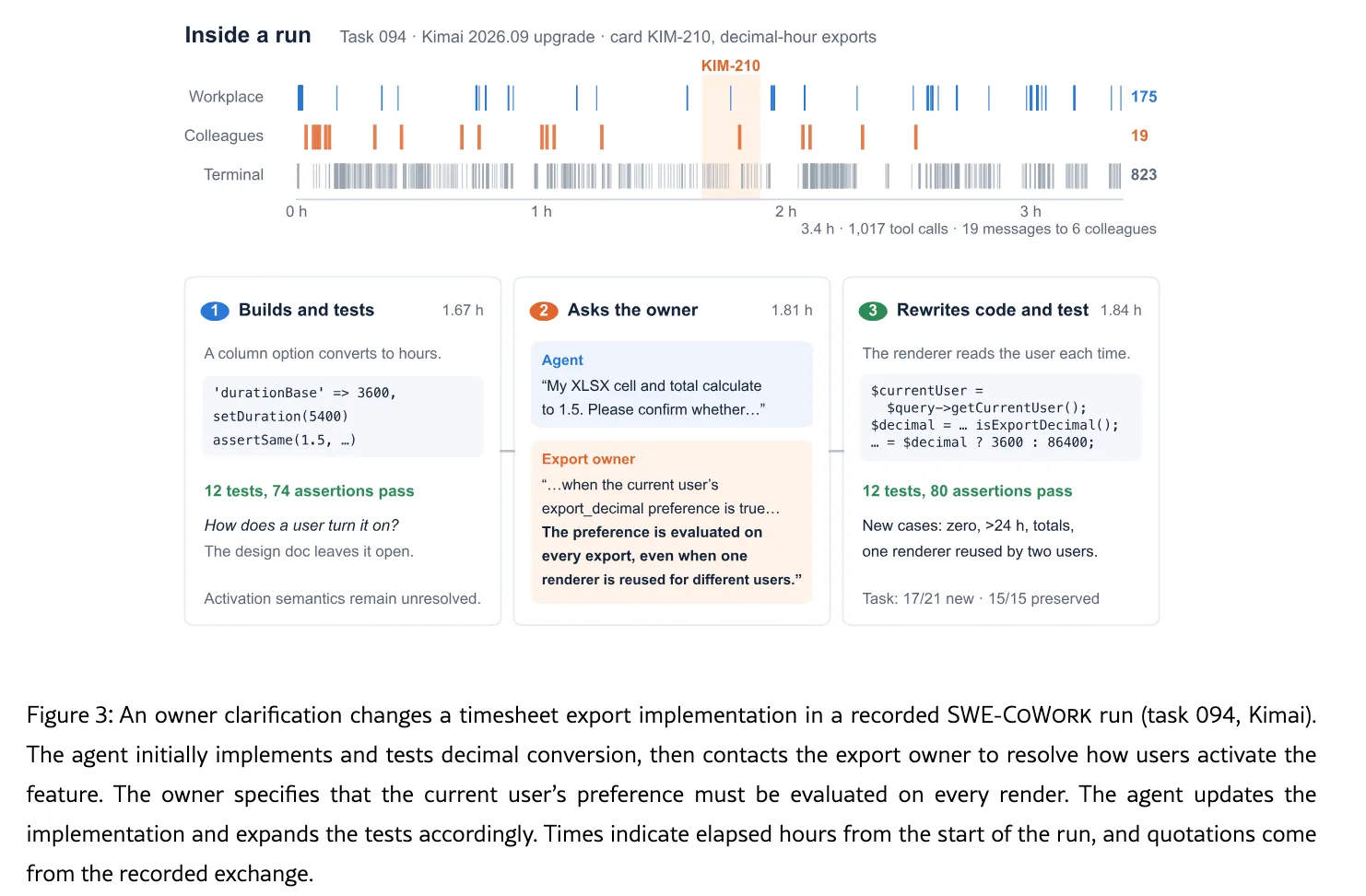
Figure 3 from the paper: in a recorded run, the agent first implements and tests decimal-hour exports, then asks the export owner how users turn the feature on. The owner’s answer changes the requirements, so the agent rewrites the code and expands its tests.
The results show that even the best models, GPT-6 Astra and Claude Opus 5.5, fail at more than 90% of the tasks. All other models fail at almost 100%.
The core challenge seems to be the models’ inability to keep track of requirements across the many steps of the work, keeping the full task in scope and under control. There is also a kind of laziness: not exploring fully, and not making sure that every test passes and every task is done. In fact, 31% of the requirements the models reported as completed still fail their tests. And the models struggle to work with conflicting information.
This is an interesting benchmark, and it will be interesting to see how the results develop. However, these also feel like the same challenges humans face, and I truly missed a human baseline showing how average humans do in this evaluation setup. My assumption is that they, too, would be very far from 100%.
It is also interesting that, for all the talk of open-source models getting ever closer, the difference here in fully completed tasks is almost an order of magnitude.
The results are also relevant to the discussion of “good enough” intelligence: the idea that frontier intelligence will become increasingly irrelevant for most tasks, as even second-tier models are able to do most economically relevant work. SWE-CoWork shows that we are still quite far from that point. At least in this case, frontier intelligence, and even next-generation frontier intelligence, is still needed to improve at core economic work.
Source: SWE-CoWork: Benchmarking Coding Agents as Digital Employees in Organizations
