Frontier AI in 2026 - Part 1/4: Generative UI
Predicting the frontier of applied AI for 2026 almost feels absurd at today’s pace. Still, one useful heuristic is to extend the major 2025 trends. If they continue, 2026 looks eventful—so this is just part 1 of 4.
Generative AI’s impact on software isn’t (just) faster coding, but redefining what an app is. One year ago mainstream AI-assisted development was still mostly “chat + patch,” with tools like GitHub Copilot Chat suggesting snippets, explaining code, and just starting with in-file edits.
Across 2025, two major shifts became mainstream: repo-level coding agents that work across entire codebases, running tests and linters and iterating until tasks are complete; and “vibe coding,” which shifts development away from interacting with code toward expressing intent, with the system responsible for turning that intent into working software.
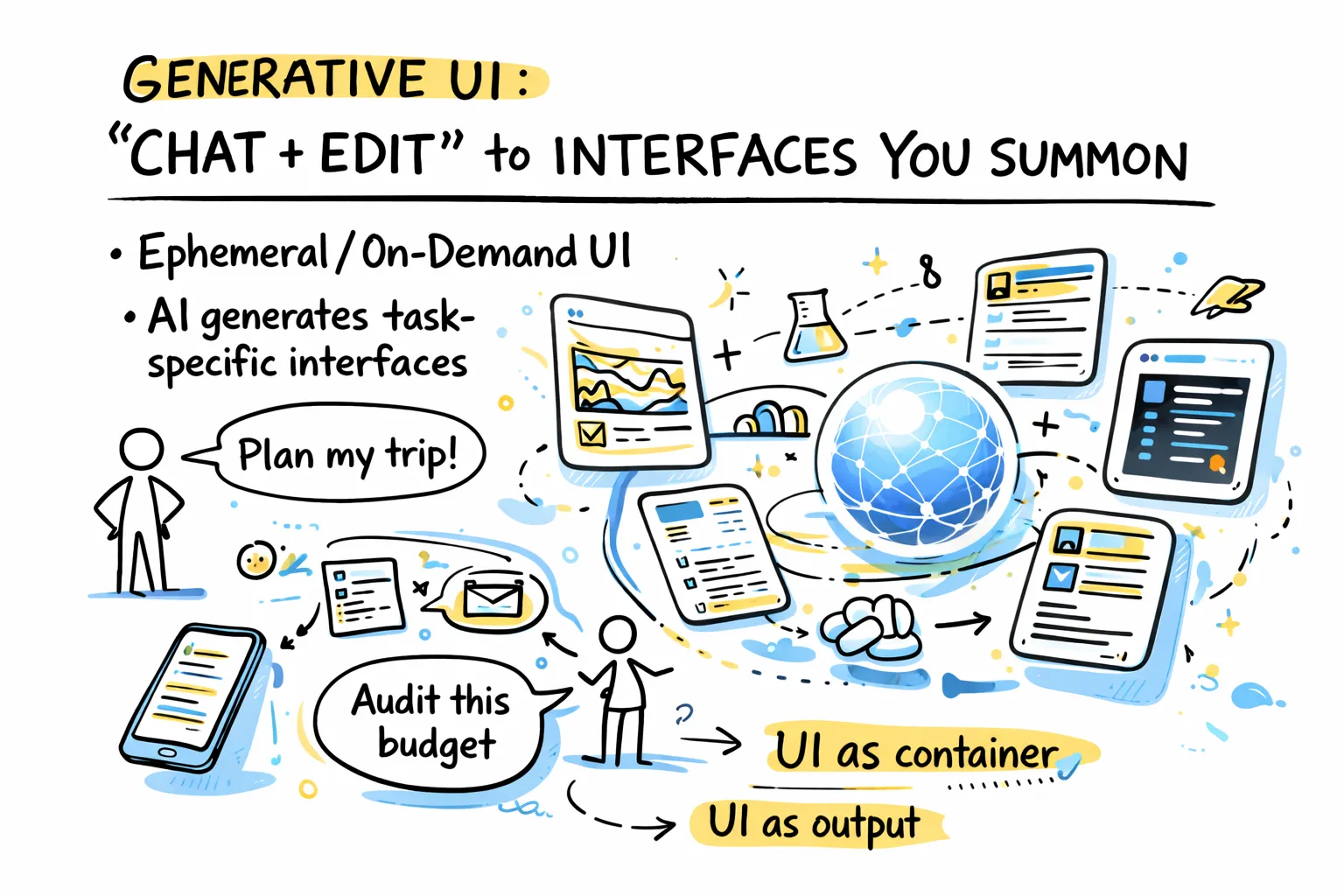
Now we’re seeing the start of a third phase: apps being created and discarded on the fly as part of a dialogue. Instead of a fixed UI that contains the AI, the AI increasingly generates the UI that best fits the user’s goal in that moment. Google refers to this as Generative UI: dynamically generating interactive interfaces (pages, tools, simulations) tailored to a prompt.
In 2026 expect more “UI as output,” not “UI as container.” You’ll increasingly ask for outcomes — “plan my trip,” “audit this budget,” “design a landing page” — and receive a bespoke, interactive interface that’s generated, used, and then disappears.
This is Part 1 of a four-part series. Coming next: agents with real agency, long-horizon reliability, and the move from multimodal towards world models and simulation.