Frontier AI in 2026 - Part 2/4: Agents with agency
Predicting the frontier of applied AI for 2026 almost feels absurd at today’s pace. Still, one useful heuristic is to extend the major 2025 trends. If they continue, 2026 looks eventful—so this is part 2 of 4.
If Part 1 argued that generative AI is redefining what an app is, Part 2 is about redefining what an agent is.
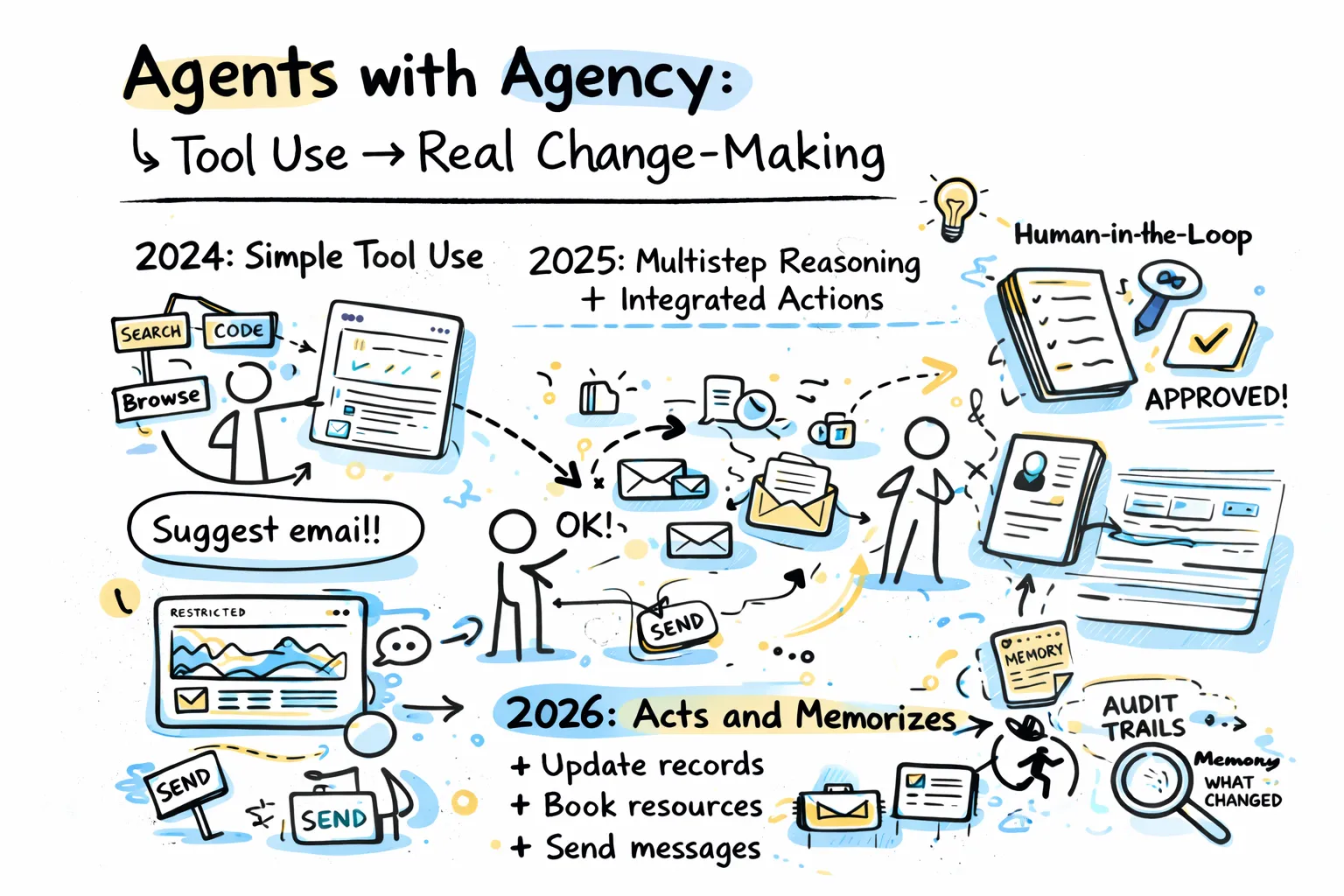
In early 2025, “agentic” systems were often little more than structured retrieval: fetch documents, follow a predefined workflow, produce an answer. Useful, but largely confined to reasoning about the world rather than acting in it.
Across 2025, two shifts pushed this forward. First, reasoning-first models became mainstream—systems trained to invest more compute in multi-step planning instead of producing a fast first draft. Second, integrated tool use stopped being a novelty and became an expectation: web search, code execution, browsing, and multi-step research increasingly worked as a single loop rather than isolated features.
Yet even now, most agents remain incomplete. Outside of narrow sandboxes, they can draft emails but not send them, suggest meetings but not book them, recommend edits but not reliably apply them across real systems. Intelligence has outpaced impact. By and large they do not remember what they learned on the last assignment.
In 2026, the next step is completing the agent. That means shifting agency away from abstract reasoning toward permissioned action. Expect more systems that can actually write to the world—sending messages, updating records, booking resources—by default gated through explicit approvals. Human-in-the-loop won’t be an afterthought; it will be the core design pattern, paired with strong audit trails that make actions legible: what happened, why it happened, and what changed.
Memory completes this loop. Long the weakest link in agent design, persistent personal and project memory is becoming a first-class product surface. When an agent reliably remembers your preferences, context, and ongoing work—and can act on them safely—it stops being a tool you query and becomes an assistant you rely on. At that point, switching isn’t just inconvenient; it’s costly.
This is Part 2 of a four-part series on where applied AI is heading in 2026.
Coming next: how new benchmarks and training regimes push models from hill-climbing toward long-horizon reliability, and why consistency—not raw capability—may become the defining constraint.