Frontier AI in 2026 - Part 3/4: Hill-climbing to long-horizon reliability
Predicting the frontier of applied AI for 2026 almost feels absurd at today’s pace. Still, extending the major 2025 trends gives us a useful heuristic—and by that logic, 2026 looks eventful. This is part 3 of 4.
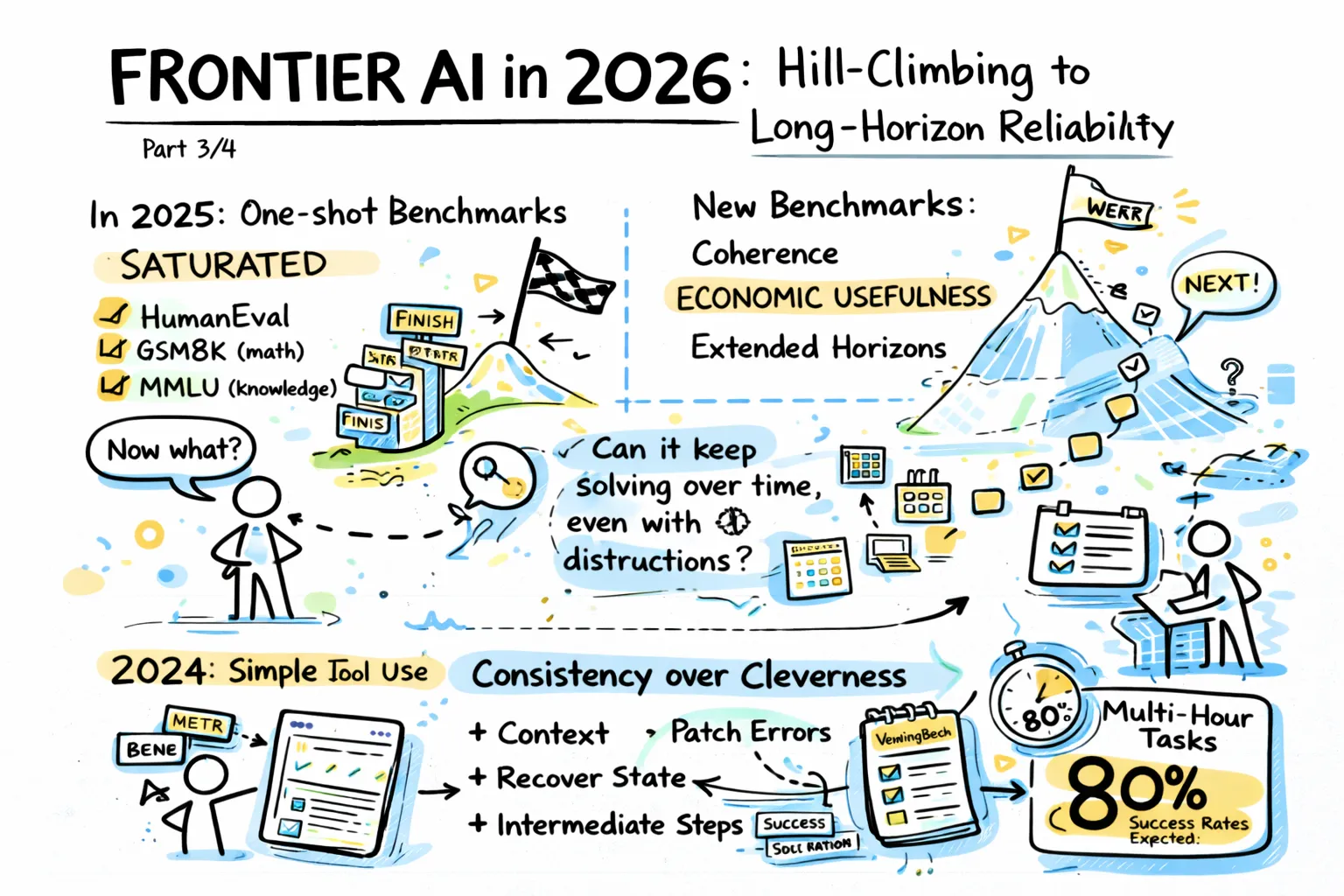
A recurring pattern in AI progress is deceptively simple: once a cognitive skill becomes measurable, it becomes optimizable. Progress then accelerates—until the benchmark saturates and stops distinguishing frontier systems. We saw this clearly in 2025. Benchmarks like HumanEval (functional code correctness), GSM8K (grade-school math), and MMLU (broad multitask knowledge) largely saturated.
That raises the obvious question: what gets optimized next?
The answer isn’t smarter single responses—it’s reliable performance over time without relying on perfectly prepared inputs. The most important new benchmarks don’t ask “can the model solve this problem?” but “can it keep solving related problems correctly, without drifting, over extended horizons and in the presence of superfluous information?”
New benchmarks increasingly target this gap by reframing capability around time horizons, coherence, and economic usefulness rather than single-shot correctness. Benchmarks like METR, GDPval or VendingBench2 and SWE-Bench Pro, along with long-horizon planning environments, all point in the same direction.
Taken together, these benchmarks pull progress away from cleverness and toward consistency. They reward models and systems that can maintain context, manage intermediate state, recover from errors, and avoid compounding mistakes.
By the end of 2026, we should expect systems that can complete multi-hour tasks with high reliability—on the order of 80% success rates—where today even a dozen uninterrupted minutes is still a challenge.
This is Part 3 of a 4 series on where applied AI is heading in 2026. Coming next: from multimodal input to world models—why controllable simulation may be the next interface for intelligence.