Frontier AI in 2026 – Part 4/4: From multimodal chat to world models
Predicting the frontier of applied AI for 2026 almost feels absurd at today’s pace. Still, extending the major 2025 trends gives us a useful heuristic—and by that logic, 2026 looks eventful. This is part 4 of 4.
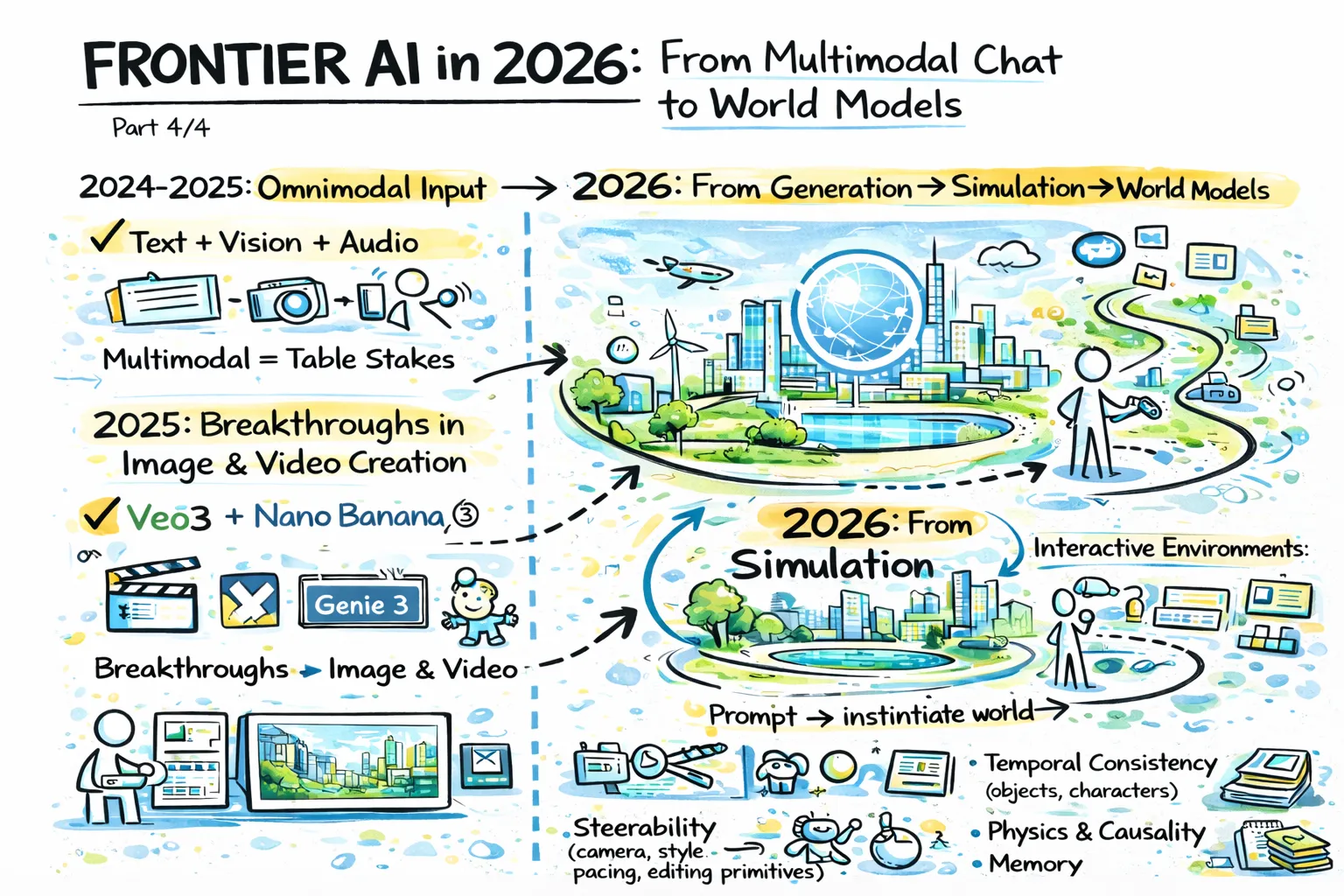
We entered 2025 already in the era of “omnimodal” models—systems that can work fluently across text, vision, and audio. Multimodality itself was no longer novel; it had become table stakes.
What changed in 2025–2026 was not just better input, but radically stronger output. Image generation crossed a threshold where instruction-following, layout control, and editability enabled structured artifacts like storyboards and multi-panel concepts. Video and audio generation pushed toward higher fidelity, tighter prompt adherence, and synchronized sound.
More importantly, we started to see the next abstraction emerge: interactive worlds. Early “world model” systems no longer just generate media; they generate environments you can navigate, probe, and influence in real time.
As a result, the frontier is already shifting away from raw generation quality—video, in particular, feels “solved enough” for many use cases. The hard problems now are different: steerability (camera, style, pacing, editing primitives), temporal consistency (objects and characters staying coherent over time), physics and causality (believable dynamics rather than pretty frames), and interactivity (moving from content you watch to spaces you can act in).
In 2026, this completes a broader transition. We’ll talk less about “multimodal models” and more about promptable simulation engines—systems where the output isn’t just text, images, or video, but an interactive, editable representation of a world. Instead of asking an AI to describe or render reality, we’ll increasingly ask it to instantiate one.
This is the final part of a four-part series on where applied AI is heading in 2026. To complete the picture, we will next look at the factors that are all but guaranteed to remain unchanged next year.