Agents and Their Structural Dimensions
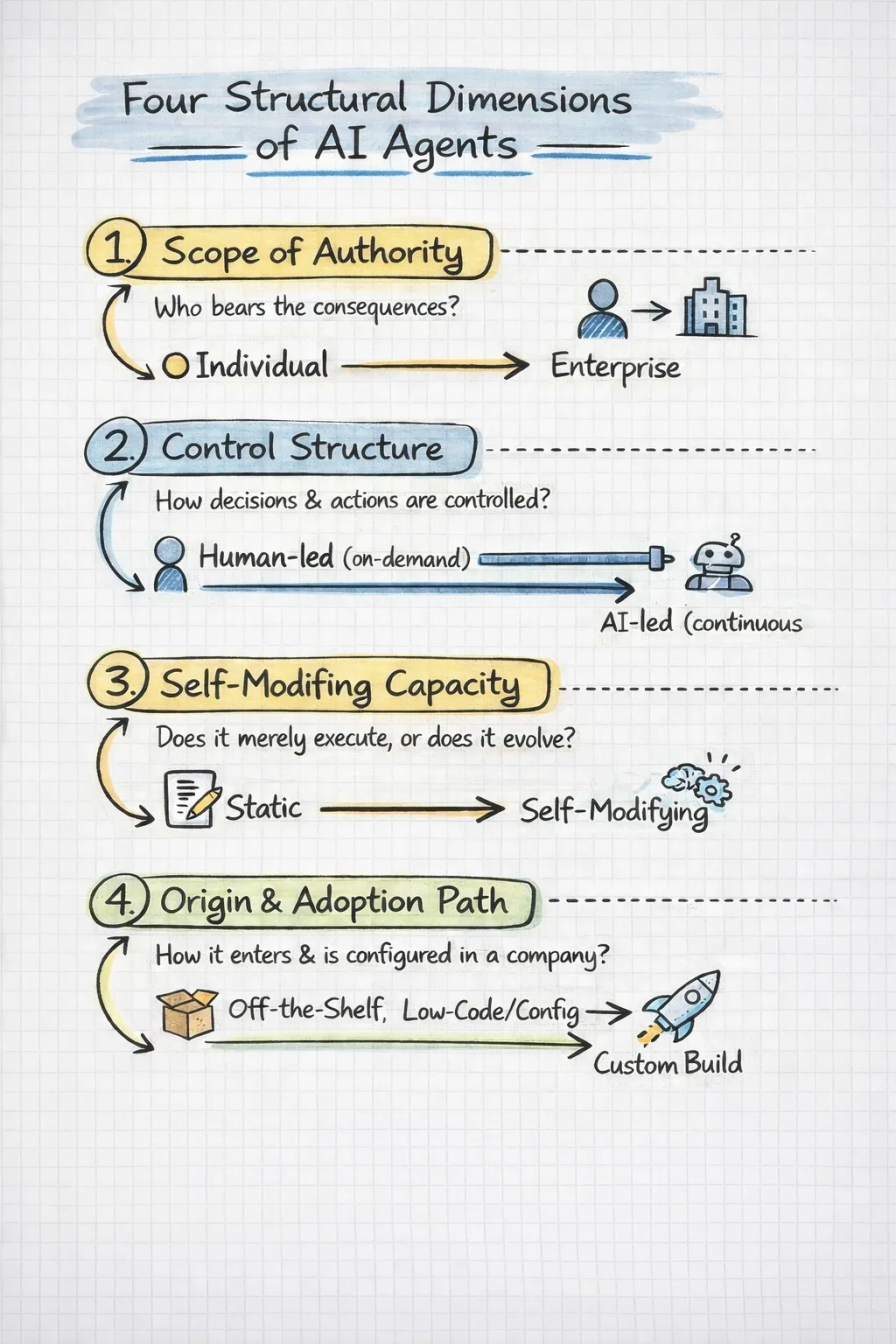
""Agents” - The term now covers everything from autocomplete to systems that manage infrastructure. Used loosely, it causes more confusion than anything. Trying to bring some order to the chaos, four structural dimensions seem useful to me:
-
Scope of authority — who bears the consequences? An agent may operate for an individual user, or with enterprise-wide authority. A personal coding assistant affects one developer. An AI system approving refunds or trades affects the balance sheet.
-
Control structure — who controls decisions and action? Some systems are human-led, acting only on demand. Others are AI-led, operating continuously once deployed. GitHub Copilot remains firmly human-directed; an autonomous incident-response system is not.
-
Self-modifying capacity — does it merely execute, or does it evolve? Some agents are structurally static, defined by prompts and rules. Others adapt strategies or models based on outcomes. The difference has implications for both compounding capability and compounding risk.
-
Origin and adoption path — how does it enter the organisation? An agent may be purchased off the shelf, configured via low-code tools, or built internally from scratch. Microsoft Copilot for Microsoft 365 arrives as a product; an AI trading system is typically custom-engineered.
Does this resonate with you? Do you know of taxonomies that allow to give different kind of agents a more precise definition?